


























Whether in the workshop, on the construction site or at home: The Festool App is your companion for smart working and perfect results.
Scan the QR code and install the app.
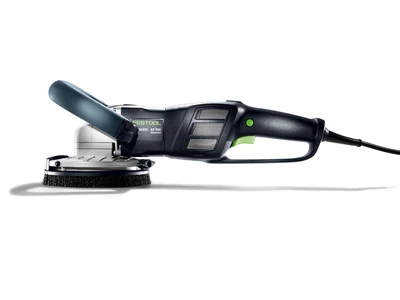
Planed wood surfaces have so-called knife marks, also known as plane marks, caused by the Planer blades. These must be sanded before surface coating. This results in a smoother, more homogeneous surface and the surface coating has a better grip or can penetrate the wood better. If you don't have a large stationary sanding machine, this step can be carried out using a hand-held sanding machine. The ROTEX is ideal for this because it combines coarse sanding and random orbital sanding in one machine. As this work is mainly carried out in the workshop, it is advantageous to set up the workplace accordingly. That is why we would like to take a brief look at our system accessories here.
During surface sanding, the ROTEX is set to the "rotating cam track", i.e. coarse sanding. During this movement, the disc is driven by a gearbox. With the combination of eccentric and rotary movement, the ROTEX achieves up to three times the removal rate of other Eccentric sanders. To do this, the changeover switch is moved to the right in the direction of the coarse point grid.

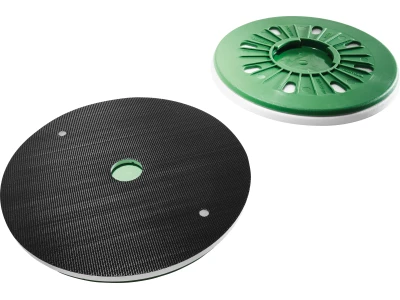
For coarse sanding, it is particularly important to achieve a flat surface. This is why you should work with the hard Sanding pad H-HT. This ensures that edges and corners are sanded less round. The disc on the ROTEX can be changed very quickly using the FastFix interface. To do this, first disconnect the mains plug and then set the changeover switch to coarse sanding. The spindle stop is then actuated. The disc is then turned anti-clockwise without tools.

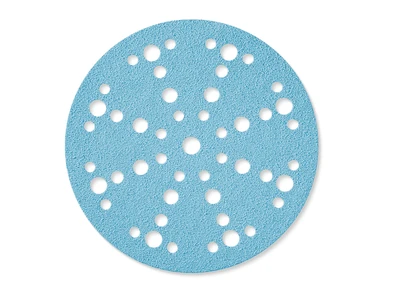
To remove any marks, we start with P80 grit - our Rubin 2 abrasive specially developed for wood sanding. Thanks to its special coating, it also clogs less quickly on resinous woods. The perfectly matched perforations ensure the best possible Dust extraction.

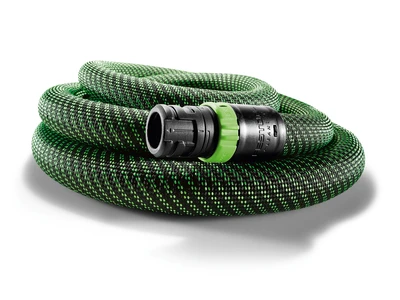
As coarse sanding generates a particularly large amount of dust, it is essential to connect a Mobile dust extractor. Mobile dust extractors of dust class M should always be used for wood dust. The Suction hose is connected to the extraction nozzle using a bayonet connection. In addition, the SYS-AIR Air purifier can filter suspended dust from the air that your vacuum cleaner does not capture.

We now use the 80 grit to sand out all visible plane marks. The machine is always guided in cross-sanding mode until no more knife marks are visible. During coarse sanding, the machine is always guided with two hands.

Once the marks have been levelled, switch to P120 grit. Now carry out one more pass in the coarse sanding setting.

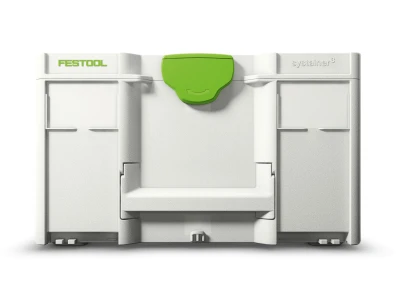
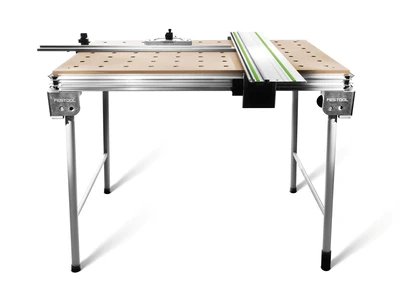
When you work with the Workcenter, you no longer have to search for Abrasives and other consumables. Everything can always be stored neatly and within easy reach next to the workstation directly on the Dust extraction unit. The sanding machine also has its place on the Workcenter and it is even possible to store a second sanding machine, e.g. for the edges.

During fine sanding, the resulting sanding marks must be sanded up so that they are no longer visible after the surface treatment. To do this, the P120 grit is initially left on the machine. The ROTEX is switched to the eccentric movement (fine sanding). The sanding marks from the coarse sanding are then removed. Here, too, work is carried out in a cross motion.

Depending on the surface coating and type of wood, sand to P150, P180 or even higher. Always follow the recommendation of the varnish or oil manufacturer. These sanding steps are also carried out in cross sanding. In the last pass, the sander is always guided lengthways to the fibre. This means that any sanding marks are not visible after the surface treatment.

For woods such as oak, it makes sense to water the surface before the final sanding. To do this, moisten the surface with a damp sponge or cloth. The wood fibres stand up and can then be levelled with a final fine sanding after drying. During intermediate sanding after the first surface coating, these fibres are already cut and the surface becomes even smoother. Soaking is also a great advantage when working with stains.


